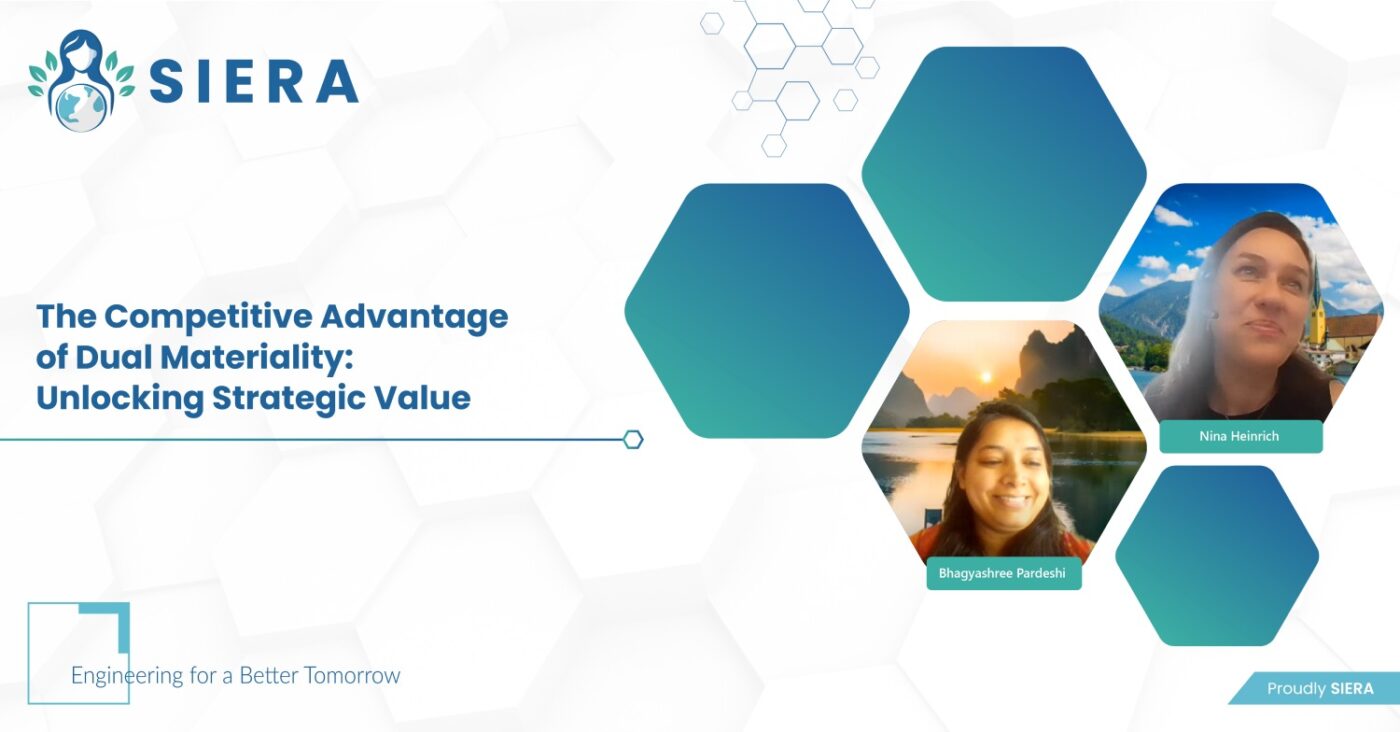
On 5 May 2026, SIERA hosted another session in the SIERA Academy – Impact Series, focused on a topic that is rapidly becoming central to corporate sustainability and business strategy: double materiality.
As organizations face growing pressure to meet CSRD and ESRS requirements, many are realizing that double materiality is not just a compliance exercise. It is a way to better understand business risk, identify strategic opportunities, strengthen governance, and create long-term value.
At SIERA, we help organizations simplify complex ESG and sustainability reporting challenges through data-driven solutions that improve transparency, decision-making, and disclosure readiness. This webinar explored how businesses can move beyond fragmented assessments and start using double materiality as a true competitive advantage.
Why Double Materiality Matters More Than Ever
Double materiality is increasingly shaping how companies approach ESG, risk management, and regulatory compliance.
At its core, double materiality looks at two perspectives:
- Inside-out impact: how a company’s activities affect people, society, and the environment
- Outside-in financial materiality: how sustainability issues create risks and opportunities for the business
This integrated view is becoming essential under EU reporting frameworks. As highlighted during the webinar:
- By 2026, nearly 50,000 EU companies and more than 10,000 non-EU firms are expected to fall within the scope of CSRD and ESRS reporting
- While many companies already conduct some form of materiality assessment, only a smaller share are fully applying double materiality
- Many organizations still assess impact materiality and financial materiality separately, limiting their ability to generate strategic insight
SIERA emphasized that when done well, double materiality creates a clearer connection between sustainability priorities, business performance, and stakeholder expectations.
Key Challenges Organizations Are Facing
The webinar outlined three common barriers that prevent companies from unlocking the full value of double materiality.
1. Fragmented Data and Inconsistent Insights
Many organizations still manage sustainability, financial, and compliance data across disconnected systems.
This often leads to:
- Siloed assessments of impact and financial materiality
- Inconsistent reporting methodologies
- Manual spreadsheet-heavy workflows
- Delays in analysis and reporting
- Limited visibility into strategic priorities
Instead of using materiality insights to support business decisions, teams often spend too much time reconciling data from multiple sources.
2. Regulatory Complexity and Compliance Burden
Double materiality requirements under CSRD, ESRS, and related EU frameworks are complex and evolving.
Organizations are expected to assess a wide range of environmental, social, and governance topics, including:
- Climate change and GHG emissions
- Pollution
- Biodiversity loss
- Working conditions
- Employee relations
- Inequalities
- Diversity and inclusion
- Health and safety
- Bribery and corruption
- Board diversity and governance structures
Frequent regulatory updates and manual interpretation of guidance create a heavy compliance burden, especially for teams without scalable systems in place.
3. Limited Internal Expertise
Another major issue discussed in the webinar was capability.
Many businesses do not yet have the internal ESG, sustainability, or analytics expertise required to:
- Interpret double materiality requirements confidently
- Connect impacts, risks, and opportunities across the value chain
- Translate findings into strategy and governance actions
- Build long-term ownership of the materiality process
As a result, organizations often become overly dependent on external consultants, increasing costs and reducing internal resilience.
The Strategic Opportunity Behind Double Materiality
A key message from the webinar was that double materiality should not be treated as a reporting burden alone.
When approached strategically, it can help organizations:
- Improve risk management
- Strengthen decision-making
- Support decarbonization priorities
- Increase stakeholder trust
- Build stronger foundations for regulatory readiness
SIERA highlighted that double materiality helps companies focus on the issues that matter most, both from a business perspective and from a societal and environmental perspective. This enables more effective prioritization, better allocation of resources, and clearer communication with regulators, investors, and customers.
Practical Solutions Discussed in the Webinar
To address these challenges, the session explored several practical, data-driven approaches that can help organizations operationalize double materiality more effectively.
1. Integrated Double Materiality Data Hubs
An integrated data hub can centralize the information used in materiality assessments across departments and business functions.
Benefits include:
- A unified view of impact and financial materiality
- Improved data accuracy and traceability
- Faster reporting cycles
- Stronger audit readiness
- Real-time links to strategy, risk, and governance dashboards
This kind of centralized approach helps organizations replace fragmented processes with a more credible and scalable framework.
2. Data-Driven Double Materiality Integration
The webinar also covered the value of structured workflows that support:
- Consistent collection of quantitative and qualitative inputs
- Automated mapping of impacts, risks, and opportunities
- Reduced interpretation gaps
- Dynamic dashboards for disclosure readiness
- Export-ready outputs for reporting and strategic planning
This approach helps reduce compliance complexity while making materiality insights more useful across the business.
3. Data-Driven Materiality and IRO Identification
Systematic identification of impacts, risks, and opportunities (IROs) is critical to building a robust double materiality process.
The webinar showed how organizations can benefit from methods that:
- Link material topics to ESG impacts across operations and value chains
- Improve consistency in prioritization
- Connect materiality scoring to business risk
- Help leaders understand where sustainability impact and financial exposure intersect
This is where SIERA’s approachbecomes especially valuable. By supporting structured, explainable, and data-backed ESG workflows, SIERA enables organizations to move from uncertainty to action.
Positive Outcomes Organizations Can Expect
The session also highlighted the positive business outcomes that come from a more mature and integrated double materiality process.
These include:
- Faster responses to stakeholder and disclosure requests
- Higher credibility through structured data and explainability
- Clearer focus on what should be reported and why
- Ongoing visibility into sustainability performance and reporting progress
With a standardized and defensible process, companies are better positioned to respond efficiently, communicate confidently, and build trust with key stakeholders.
How SIERA Supports This Journey
Throughout the webinar, it was clear that organizations need more than just guidance, they need practical systems that make complex ESG reporting manageable.
SIERA helps businesses strengthen sustainability reporting and regulatory readiness by enabling:
- Better ESG data organization
- More consistent disclosure workflows
- Clearer materiality assessments
- Improved traceability and explainability
- More strategic use of sustainability insights
As reporting expectations continue to evolve, organizations need solutions that connect compliance, performance, and business value. SIERA’s data-driven approach is designed to help companies do exactly that.
Final Thoughts
Double materiality is no longer a future concept. It is becoming a business imperative.
The webinar made one point especially clear: companies that embrace double materiality early and integrate it effectively will be in a stronger position to manage risk, improve transparency, and create strategic advantage.
Rather than seeing it as another reporting obligation, organizations should view double materiality as a powerful framework for sharper decisions, stronger governance, and more resilient growth.
Join SIERA’s Upcoming Webinars and Events
Want to stay ahead of ESG reporting, double materiality, and sustainability strategy?
Join SIERA’s upcoming webinars and events to gain practical insights, explore emerging regulatory developments, and learn how data-driven ESG reporting can support better business outcomes.
Whether you are preparing for CSRD, refining your sustainability strategy, or looking to strengthen disclosure readiness, SIERA’s event series is designed to help you take the next step with confidence.
Engineering for a Better Tomorrow.