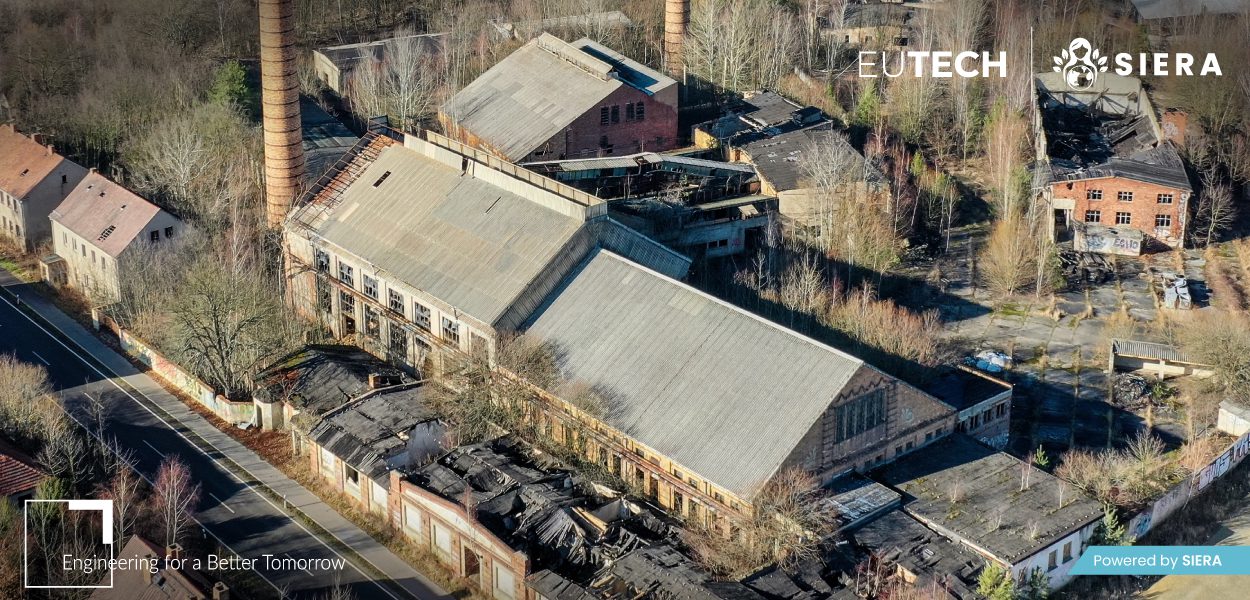
Across Europe, land is becoming an increasingly scarce and contested resource. Rapid urbanization, climate targets, infrastructure expansion, and renewable energy development are increasing pressure on available land. As a result, governments, investors, and planners are increasingly focusing on brownfield redevelopment—the transformation of previously used or contaminated land into productive and sustainable spaces.
These developments were explored in detail during a SIERA Impact Webinar hosted on EUTECH – powered bySIERA, where environmental engineering experts examined the policy landscape, the growing demand for brownfield redevelopment, and the solutions required to unlock these sites.
Through initiatives such as the SIERA Academy Impact Series webinars on EUTECH – powered by SIERA, industry leaders, policymakers, and environmental engineers exchange knowledge and best practices for addressing complex sustainability challenges. The webinar highlighted why brownfields are becoming strategically important across Europe and how integrated environmental engineering approaches can accelerate their transformation.
Why Brownfields Are Becoming Strategically Important
Urban expansion, climate commitments, and infrastructure development are placing increasing pressure on land resources across Europe. Governments are therefore prioritizing the reuse of existing sites to minimize environmental impact while enabling economic development.
Germany provides a clear example of this challenge. In the state of North Rhine-Westphalia (NRW), approximately 5.6 hectares of land are converted every day for settlement and transport infrastructure. This equals roughly eight football fields per day, and over a decade the cumulative area would match the size of the city of Düsseldorf.
At the same time, thousands of underutilized brownfield sites exist across the region. In NRW alone, around 90,000 contaminated sites have been identified, with more than 9,200 brownfield locations covering approximately 8,801 hectares outside the Ruhr area.
These figures demonstrate why brownfields are gaining strategic importance. Instead of continuing to develop new land, policymakers increasingly emphasize reusing existing sites to balance economic growth, environmental protection, and climate commitments.
Discussions around these issues are increasingly taking place in expert forums such as EUTECH– powered by SIERA, where environmental engineering professionals share insights into sustainable land use strategies.
Policy Drivers Behind Brownfield Redevelopment
Across Europe and Germany, several policy and economic factors are driving increased demand for brownfield redevelopment.
Key drivers include:
- Climate neutrality targets
- Expansion of renewable energy infrastructure
- Urban densification policies
- Reduction of land sealing and land consumption
- Public funding programs supporting regeneration
These drivers reinforce a broader policy shift toward a “Brownfield-First” approach, which prioritizes redevelopment of existing land before developing new greenfield areas.
EU Programs Supporting Brownfield Development
Several European funding programs and policy initiatives support the redevelopment of degraded land and contaminated sites.
These initiatives provide financial support for remediation projects, research programs, and sustainable urban development.
| EU Initiative | Objective | Impact on Brownfield Development |
| Horizon Europe – Living Labs | Pilot projects for soil remediation | Demonstration projects for brownfield regeneration |
| EU Cohesion & Regional Development Funds | Funding for urban regeneration | Financial support for brownfield reuse |
| LIFE Programme | Environmental and climate action funding | Supports remediation and restoration |
| EU Soil Mission | Improve the health of 75% of degraded soils by 2030 | Encourages redevelopment of degraded land |
| National Funding Programs | Support through national agencies such as KfW | Enables municipalities to initiate regeneration |
These programs reflect a growing recognition that brownfields can play an important role in climate mitigation, urban development, and sustainable land management.
Through expert discussions on EUTECH– powered by SIERA, stakeholders continue to explore how these policy instruments can accelerate sustainable redevelopment projects.
Sustainable Finance and Brownfield Investments
Environmental finance is becoming a powerful driver of brownfield redevelopment. Investors increasingly align their portfolios with sustainability frameworks and climate goals.
Several financial mechanisms now support environmentally responsible land regeneration:
- Green Bonds
- Green Loans
- Sustainability-Linked Loans (SLLs)
- EU public funding instruments
- SFDR Article 8 and 9 investment funds
Why Brownfield Projects Often Face Delays
Despite increasing policy support and financial opportunities, brownfield redevelopment projects often face delays due to complex technical and regulatory challenges.
Several key barriers were highlighted during the webinar:
Lengthy Approval Processes
Regulatory approvals for complex brownfield projects can take 20–28 months, as environmental, construction, and contamination assessments must be conducted across multiple authorities.
Extensive Investor Due Diligence
Investors frequently require six to nine months of additional due diligence to evaluate environmental liabilities, ESG compliance, and contamination risks.
Municipal Risk Burden
Municipalities often face difficulties managing the financial risks associated with environmental remediation.
The SIERA Alliance Approach to Sustainable Land Transformation
The SIERA Alliance brings together leading environmental engineering companies with extensive experience in sustainability projects across Germany.
The alliance combines technical expertise with sustainable investment strategies and coordinated project implementation.
Its mission focuses on:
- Connecting expertise and capital for sustainability projects
- Delivering measurable environmental impact
- Supporting responsible land use and regeneration initiatives
Through discussions, the alliance shares knowledge, research insights, and real-world project experiences with a broader international audience.
Real-World Examples of Brownfield Transformation
Several successful redevelopment projects in Germany demonstrate how brownfields can be transformed into vibrant urban and ecological spaces.
Examples highlighted during the SIERA Impact Webinar on EUTECH– powered by SIERA include:
- Heilbronn – transformation of a former glassworks into a sustainable urban district (BUGA 2019)
- Achern – biological remediation enabling sustainable reuse of a former industrial site
- Lübeck – redevelopment of a freight rail station into a residential district
- Osnabrück Lokviertel – revitalization of a former rail yard into an urban quarter
- Lüneburg Illmenaugarten – redevelopment of a former railway facility into modern urban space
These projects illustrate how brownfield sites can evolve from environmental liabilities into valuable urban assets.
Conclusion
Brownfield revitalization is becoming a central pillar of sustainable urban development in Europe. By combining environmental engineering expertise, strategic financing mechanisms, and coordinated planning, previously contaminated land can be transformed into thriving communities.
Initiatives such as the SIERA Impact Webinar series hosted on EUTECH– powered by SIERA demonstrate how collaboration between engineers, policymakers, and investors can accelerate sustainable land transformation.
To explore more insights from sustainability experts and environmental engineers, visit EUTECH– powered by SIERA and discover upcoming sustainability discussions and expert sessions in the EUTECH Event Calendar.
You can also explore upcoming expert discussions in the SIERA Academy Impact Series webinars and stay connected with industry leaders shaping the future of environmental engineering and sustainable infrastructure.
If you would like to explore more sustainability innovation, environmental engineering, and global collaboration opportunities, discover upcoming discussions and expert-led sessions through EUTECH Hybrid Events. These events bring together industry leaders, policymakers, and sustainability professionals to exchange insights and advance solutions for a more sustainable future.
Engineering for a Better Tomorrow