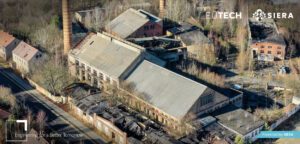
Daily land consumption for settlement and transport in Germany currently amounts to around 56 hectares – equivalent to approximately 220 km² per year. To achieve the political and societal goal of net-zero land consumption by 2050, a fundamental shift in strategy is required: away from new land sealing and toward the intelligent reuse of previously developed sites. This is precisely where brownfields come into focus as a cornerstone of sustainable urban and infrastructure development.
As part of the SIERA Academy – Impact Webinars, discussions on 10 February 2026 focused on how brownfields can be successfully revitalized despite contamination, geotechnical risks, biodiversity requirements, regulatory complexity, and cost uncertainties. The key message was clear: through structured environmental engineering, integrated planning, and interdisciplinary expertise, brownfields can be developed safely, in compliance with regulations, and in an economically viable manner – fully aligned with Engineering for A Better Tomorrow.
What Are Brownfields?
The German Brownfield Association (DEBV) defines brownfields as:
“Previously used land, with or without buildings or structures, whose redevelopment may be hindered by the potential presence of contaminants, existing buildings, or other burdens, and which requires tangible or intangible investments for new development.”
In Germany, there are an estimated around 150,000 hectares of brownfields. These sites are generally already serviced by infrastructure and covered by planning regulations, representing a significant opportunity for a sustainable land-use strategy—provided that risks are identified at an early stage and managed professionally.
Why Brownfields Are Essential for Net-Zero by 2050
A sustainable land-use policy is based on three core principles:
- Reducing daily land consumption to below 30 hectares by 2030
- Avoiding new land sealing through inward development
- Activating existing land reserves through brownfield revitalization
Brownfields make a direct contribution to:
- Resource efficiency and the circular economy
- Reduction of CO₂ emissions
- Protection of biodiversity and open spaces
- Strengthening urban sustainability
Typical Challenges in Brownfield Development
The development of brownfields is complex. The SIERA Academy Impact Webinars identified four key challenges:
1. Contaminated Sites, Existing Structures, and Geotechnical Risks
Previously used sites often exhibit:
- Contamination in soil and groundwater
- Heterogeneous fill materials
- Underground infrastructure
- Suspected unexploded ordnance or mining-related damage
Solution: Red-Flag Due Diligence and Phase I Due Diligence. Through structured desktop studies, risks are identified at an early stage—ranging from site location and legacy contamination to hydrology and foundation conditions. In this context, SIERA member companies contribute their expertise in the initial assessment of building-related contaminants.
2. Biodiversity, Nature, and Climate Protection
Derelict sites often develop into valuable habitats, including:
- Biotopes with high ecological value
- Habitats of protected species such as reptiles, birds, or bats
- Locations within landscape protection areas or drinking water protection zones
Solution: Environmental Phase I Due Diligence combined with early coordination with regulatory authorities. Through structured construction and logistics planning, ecological requirements can be systematically integrated—an approach implemented, among others, by M&P Ingenieurgesellschaft mbH – member of the SIERA Alliance in remediation and species protection concepts.
3. Planning Law and Regulatory Complexity
Planning-related challenges arise from:
- Land-use and development plans
- Restrictive planning provisions
- Easements, utility corridors, or heritage protection requirements
Solution: Regulatory engineering. Specialist planning combined with early coordination with authorities, easement agreements, and targeted exemption approvals creates planning certainty. Contributions from SIERA Alliance members demonstrate how development planning can be prepared in a manner that is fully compliant with approval requirements.
4. Cost Uncertainty and Waste Management
Unknown waste compositions complicate:
- Forecasting excavation volumes
- Estimating disposal costs
- Early-stage budget planning
Solution: Cost-secure planning concepts incorporating:
- Scenario-based cost estimates
- Optimized soil and waste management
- Cut-and-fill calculations
- Remediation and dismantling planning
This integrated approach significantly increases cost certainty and reduces overall project risks.
Project Example: Secure Brownfield Revitalization for a Logistics Park
A project presented during the webinar demonstrates how a previously used site was successfully prepared for the development of a logistics park. Typical brownfield risks—existing structures, contamination, underground infrastructure, and environmental protection requirements—were identified at an early stage through due diligence.
Through structured planning, optimized soil management, and legally robust permitting strategies, the project was implemented safely, economically, and in full regulatory compliance. The result: sustainable redevelopment in line with the objective of net-zero land consumption by 2050.
SIERA Alliance: Integrated Environmental Engineering for Real Impact
The SIERA Alliance brings together 14 engineering companies into an integrated ecosystem of environmental engineering expertise. Together, the SIERA member companies cover key areas, including:
- Sustainable infrastructure
- Urban sustainability
- Climate action and emissions reduction
- Biodiversity and ecosystems
- Circular economy
- Water and soil protection
- Digital impact technologies
Through this interdisciplinary collaboration, solutions are created that holistically integrate ecological, technical, and economic requirements.
Conclusion: Brownfields as an Opportunity for Sustainable Development
The path toward net-zero land consumption by 2050 inevitably leads through the intelligent revitalization of brownfields. The combination of early-stage due diligence integrated environmental engineering, regulatory engineering, and cost-secure planning transforms complex high-risk sites into future-ready development areas.
Through its Impact Webinars and real-world project examples, the SIERA Alliance demonstrates how Engineering for a Better Tomorrow can be put into practice in a tangible and effective way.
Would you like to learn more about how brownfields can be developed safely and sustainably? Explore upcoming SIERA Academy – Impact Webinars and events in the EUTECH Event Calendar – powered by SIERA and become part of the solution for a land-efficient future.