Repurposing Power Plant Sites: From Legacy Liabilities to Future Assets
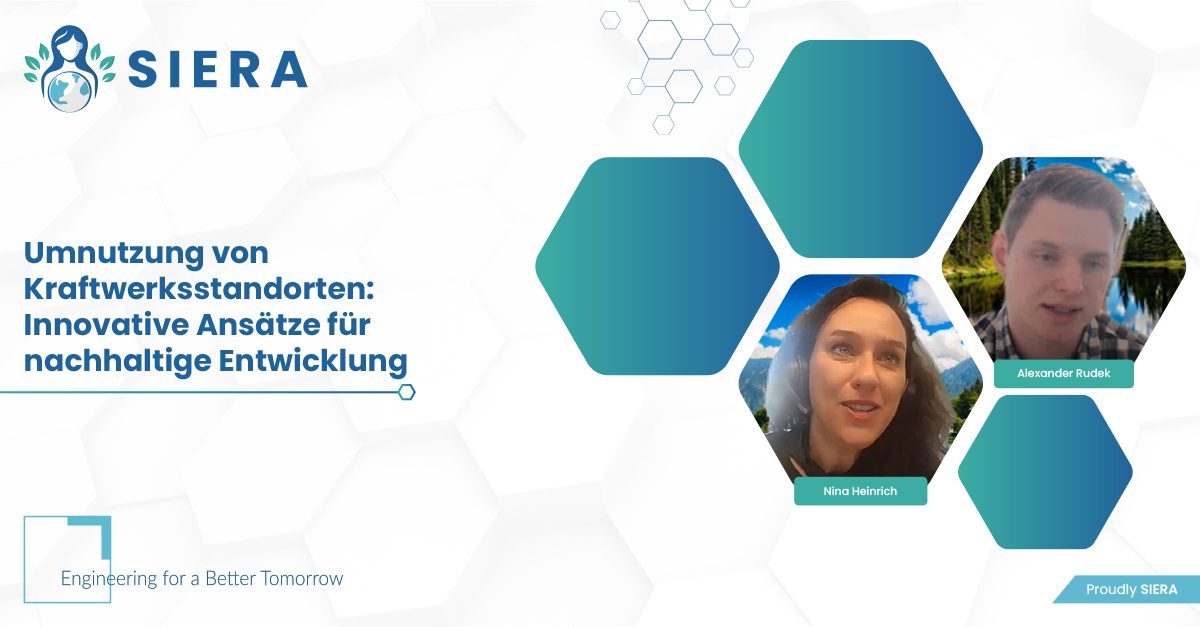
As part of the SIERA Impact Webinars, the experts of the SIERA Alliance regularly bring together practical solutions from environmental engineering. On February 26, 2026, the webinar focused on a highly relevant topic:
“Repurposing Power Plant Sites: Innovative Approaches for Sustainable Development.”
Decommissioned power plant sites are not peripheral issues of the energy transition – they are strategic key locations for sustainable infrastructure, urban transformation, and climate-resilient development. However, significant challenges lie between legacy contamination, heterogeneous subsurface conditions, and complex permitting procedures.
This article summarizes the key insights from the webinar and demonstrates how integrated solutions from the SIERA Alliance enable a safe, economically viable, and sustainable repurposing process.
Why is the repurposing of power plant sites so important?
Power plant sites often offer:
- large contiguous areas
- existing infrastructure
- transport connectivity
- an established energy-related profile
At the same time, they are frequently associated with legacy contamination and complex historical usage structures, which make further development more challenging.
The central question therefore is:
How can former power plant sites be repurposed in an ecologically and economically efficient manner?
The answer lies in a structured combination of regulatory clarity, technical depth, and consistent material flow management.
Key Potential of Repurposing
The transformation of former power plant sites offers significant added value:
- Ecological Impact
- Controlled removal and verification of historical materials
- Prevention of secondary contamination
- Creation of construction-ready site platforms
- Use of Existing Infrastructure
The continued use of existing infrastructure reduces resource consumption and project-related emissions.
- Water Protection and Pathway Control
Through targeted management of surface runoff, infiltration, and historical hotspots, long-term groundwater risks are minimized.
- Reduced CO₂ Footprint
Disciplined logistics and reuse prevent unnecessary new development and reduce embodied carbon.
These effects are not only ecologically relevant but also enhance investment security.
Three Key Challenges – and How They Are Solved
Challenge 1: Circular Economy & Material Flow Management
Large industrial sites generate significant volumes of material. Recovery and reuse options depend on soil quality and site-specific planning.
Risk:
- Mixing of materials
- Loss of reuse potential
- Cost-intensive disposal pathways
Solution: Regulatory Roadmap First
The webinar made it clear:
Start with a robust foundation regarding regulatory obligations and risks.
Implementation:
- Early coordination with authorities
- Definition of clear remediation objectives
- Advance planning of recovery and reuse pathways
- Dynamic, forward-looking material flow management
Benefits:
- Transparent cost development
- Accelerated permitting processes
- Planning certainty for investors
This is where the strength of integrated SIERA solutions becomes evident: regulatory expertise, environmental planning, and material flow coordination work seamlessly together.
Challenge 2: Heterogeneous Subsurface Conditions
Repurposing sites rarely exhibit homogeneous soil conditions.
As an example, a former coal port was described with:
- 87,000 m² of port area
- 40,000 m² of embankment area
- approximately 200,000 m³ of layered materials
Risk:
- Cross-contamination
- Delays due to insufficient preliminary investigation
- Loss of reuse potential
Solution: Intensive Supervision with Experts-in-the-Loop
Principle:
Continuous on-site supervision of the remediation process.
Implementation:
- Advance exploratory excavation trenches
- Technical experts directly at the excavation face
- Continuous sampling
- Daily documentation of material flows
Benefits:
- Optimal material separation
- Reduced disposal costs
- Early identification of irregularities
This approach combines geotechnical expertise, environmental analytics, and construction supervision – a classic example of the integrated engineering competence of the SIERA member companies.
Challenge 3: Changing Project Partners & Authorities
Large-scale projects go through numerous phases involving different stakeholders.
Risk:
- Loss of knowledge due to personal changes
- Unclear responsibilities
- Disruptions in project execution
Solution: Continuity Through Interface Management
Principle:
A permanent point of contact supports the project from start to completion.
Advantages:
- Consistent communication
- Standardized documentation
- Stable relationships with authorities
- Stronger team cohesion
Especially in complex brownfield projects, this interface function is crucial for ensuring time and cost certainty.
Overall Environmental Engineering Impact: More Than Just Remediation
The repurposing of power plant sites is not an isolated remediation project – it is a strategic transformation process.
The expertise presented in the webinar covers key environmental engineering impact areas:
| Impact Area | Contribution to Sustainable Site Development |
| Infrastructure | Sustainable, modern infrastructure |
| Urban Sustainability | Greener, more resilient cities |
| Climate | Emission reduction & resilience |
| Circular Economy | Resource efficiency & reuse |
| Water | Sustainable Water Management |
| Environmental Protection | Clean air, clean water, healthy soils |
This integrated perspective is at the core of the SIERA Alliance:
14 engineering companies – an integrated ecosystem of environmental engineering expertise.
Implementation Expertise from Practice
The presented project was implemented by M&P Ingenieurgesellschaft mbH – member of the SIERA Alliance.
With:
- 11 locations across Germany
- over 40 years of operational experience
- more than 1,000 projects per year
- 250 employees in interdisciplinary engineering and environmental services
This represents scalable experience combined with in-depth technical expertise in:
- Site investigations & contamination assessments
- Earthworks and geotechnical engineering
- Hydrogeology
- Environmental and soil management
- Biodiversity & ecological planning
- Building contaminants and hazardous materials management
This expertise exemplifies the holistic SIERA Solutions in the field of Brownfield & Site Development.
Conclusion: Regulatory Clarity, Technical Depth, Integrated Management
The repurposing of power plant sites is not achieved through isolated measures, but through:
- Early regulatory structuring
- Consistent material flow management
- Continuous expert supervision
- Ongoing project coordination
Those who integrate these elements transform legacy sites into secure, climate-resilient future assets.
Become Part of the SIERA Impact Webinars Now
The SIERA Impact Webinars regularly bring together experts of the SIERA Alliance to discuss practical solutions for:
- Brownfield development
- Climate-resilient infrastructure
- Sustainable urban transformation
- ESG-compliant project development
- Integrated environmental management
If you are facing the challenge of transforming a complex industrial site, minimizing regulatory risks, or managing material flows efficiently, the next edition of the SIERA Impact Webinars is the right forum for you.
Register now for the next SIERA Impact Webinar
and discover how integrated environmental engineering expertise enables sustainable site development.
SIERA – Engineering for a Better Tomorrow.