Introduction: Turning Risk into Opportunity with SIERA
Across Europe, building owners and developers face a growing challenge: how to renovate, repurpose, or modernize existing buildings while safely managing hazardous substances, meeting strict regulatory requirements, and keeping projects on time and on budget. This is exactly where SIERA comes into play.
As an integrated alliance of environmental engineering experts, SIERA brings together multidisciplinary expertise to tackle complex sustainability challenges across the built environment. Through initiatives such as the SIERA Impact Webinar Series, SIERA translates technical complexity into practical, real-world insights for decision-makers, planners, and practitioners.
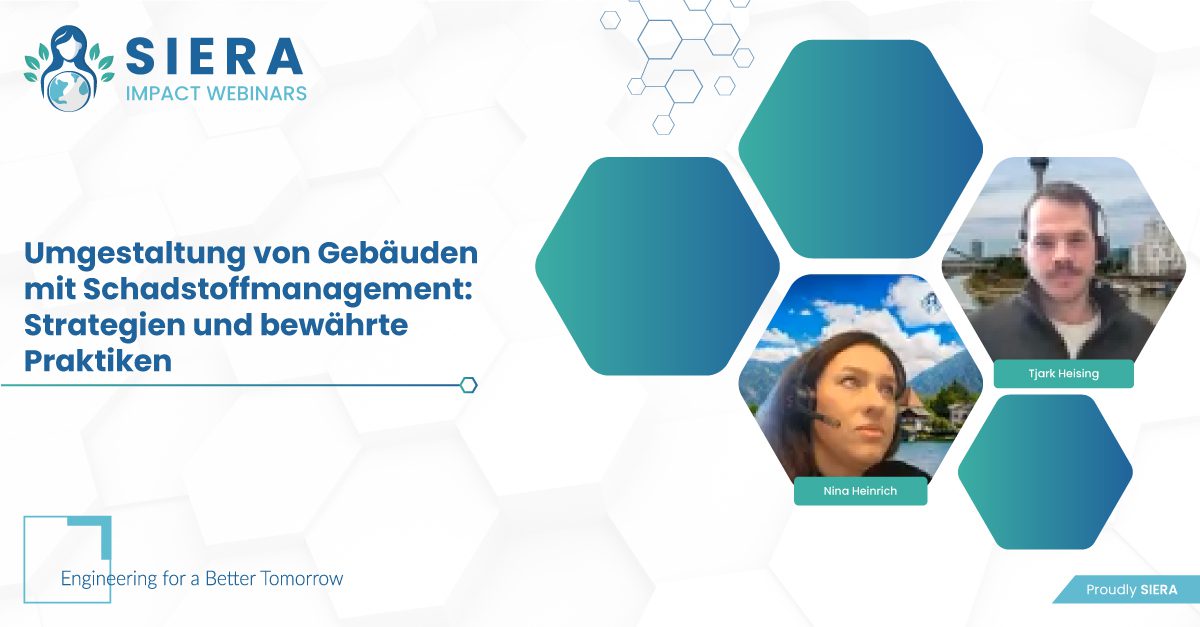
In the SIERA Impact Webinar “Transforming Buildings Through Contaminant Management – Strategies and Best Practices”, environmental engineering expert Tjark Heising (M&P Ingenieurgesellschaft) shared hands-on experience and proven approaches for managing hazardous substances in building renovation projects. The session highlighted why professional contaminant management is not just a regulatory necessity, but a strategic foundation for sustainable building transformation.
Why Contaminant Management Is Critical in Building Transformation
Many existing buildings—particularly those constructed before the 1990s—contain hazardous substances that pose serious risks if not properly identified and managed. These substances often remain hidden within building materials and only become a problem once renovation or demolition activities begin.
Tjark Heising emphasized that early identification of building contaminants is the single most important factor in ensuring safe and efficient project execution. Without it, projects face:
- Health risks for workers, occupants, and surrounding communities
- Legal and regulatory non-compliance
- Unplanned construction stops and delays
- Significant cost overruns and contractual disputes
Professional contaminant management transforms these risks into a controllable and transparent planning parameter.
Key Hazardous Substances in Existing Buildings
During the webinar, Tjark outlined the most common hazardous substances encountered in renovation projects and their implications:
| Hazardous Substance | Typical Locations | Health & Environmental Risks | Regulatory Framework |
| Asbestos | Plasters, fillers, fire protection materials | Carcinogenic, inhalation risk | Hazardous Substances Ordinance, TRGS 519 |
| PCB | Sealants, coatings | Toxic, bioaccumulative, indoor air contamination | PCB Directive, TRGS 524 |
| PAH | Adhesives, sealing membranes | Carcinogenic, skin and inhalation exposure | Hazardous Substances Ordinance, TRGS 551 |
| Artificial Mineral Fibers (KMF) | Insulation materials | Carcinogenic when inhaled | Hazardous Substances Ordinance, TRGS 521 |
Germany’s asbestos ban (since 1993) and PCB ban (since 1989) underline how outdated building materials can still pose serious risks decades later.
The Strategic Value of Early Investigations
A central message of the webinar was clear: early-stage contaminant investigations create planning certainty.
Targeted sampling and professional contaminant assessments provide:
- A reliable basis for project planning and design decisions
- A realistic and transparent cost framework for remediation and disposal
- Reduced risk of uncontrolled exposure and legal consequences
- Prevention of construction delays and emergency shutdowns
As Tjark explained, contaminant reports are not merely compliance documents—they are strategic planning tools that enable informed decision-making from the very beginning of a project.
Typical Challenges in Building Renovation Projects
Building transformation projects face multiple, interconnected challenges when hazardous substances are involved:
- Risk to People and the Environment
Hazardous substances can be released during improper removal, demolition, or disposal, affecting indoor air quality, soil, and surrounding ecosystems. - Financial Uncertainty
Undetected contaminants often lead to change orders, unexpected additional costs, or even project cancellation. - Schedule Risks
Construction stops, regulatory interventions, and contractual penalties are common consequences of insufficient planning.
According to Tjark, these risks are not exceptional—they are predictable outcomes of inadequate contaminant management.
The Solution: Professional Contaminant Assessments
The webinar highlighted contaminant assessments (Schadstoffgutachten) as the cornerstone of sustainable building transformation.
Principle:
Systematic evaluation of the building substance to identify hazardous materials.
Implementation:
- Structured sampling strategies
- Laboratory analysis
- Comprehensive documentation and risk evaluation
Impact:
- High planning reliability
- Robust cost estimates
- Reduced risk for people and the environment
- Full compliance with legal requirements
This approach enables project teams to integrate safety, sustainability, and efficiency into a single, coherent strategy.
Environmental Impact Beyond the Building
Effective contaminant management has far-reaching environmental benefits that extend beyond the construction site:
- Air: Prevention of hazardous substance dispersion into the atmosphere
- Soil: Avoidance of contamination during removal and disposal
- Water: Protection of groundwater and surface water resources
- Biodiversity: Reduced disturbance to surrounding ecosystems
These outcomes directly align with SIERA’s environmental engineering mission: achieving real, measurable impact through technically sound solutions.
SIERA’s Role: Engineering for a Better Tomorrow
As an alliance of 14 engineering companies, SIERA provides an integrated ecosystem for environmental engineering excellence. In the context of building transformation, this means combining:
- Environmental and hazardous substance expertise
- Geotechnical and structural engineering
- Planning, permitting, and compliance know-how
With more than 40 years of operational experience and over 1,000 projects per year, SIERA member companies turn regulatory complexity into engineering clarity.
Key Takeaways from the Webinar
- Hazardous substances are a central risk factor in building transformation—but also a manageable one
- Early contaminant investigations are essential for cost control, safety, and compliance
- Professional contaminant assessments enable sustainable, future-proof renovation strategies
- Integrated environmental engineering is the foundation of successful building transformation
As Tjark Heising concluded, sustainable renovation starts long before construction begins, it starts with knowledge.
Join the SIERA Impact Webinar Series
Do you want to understand how environmental engineering can turn complex renovation challenges into sustainable success stories?
The SIERA Impact Webinar Series brings together experts from across the SIERA Alliance to share practical insights, real-world case studies, and forward-looking strategies on topics ranging from contamination management and brownfield redevelopment to climate resilience and ESG compliance.
👉 Explore upcoming SIERA Impact Webinars and register to gain actionable insights from leading environmental engineering experts.
If you are planning a building renovation or transformation project, contact SIERA to learn how our integrated, end-to-end approach can support your goals—from early assessment to long-term value creation.
SIERA – Engineering for a Better Tomorrow.