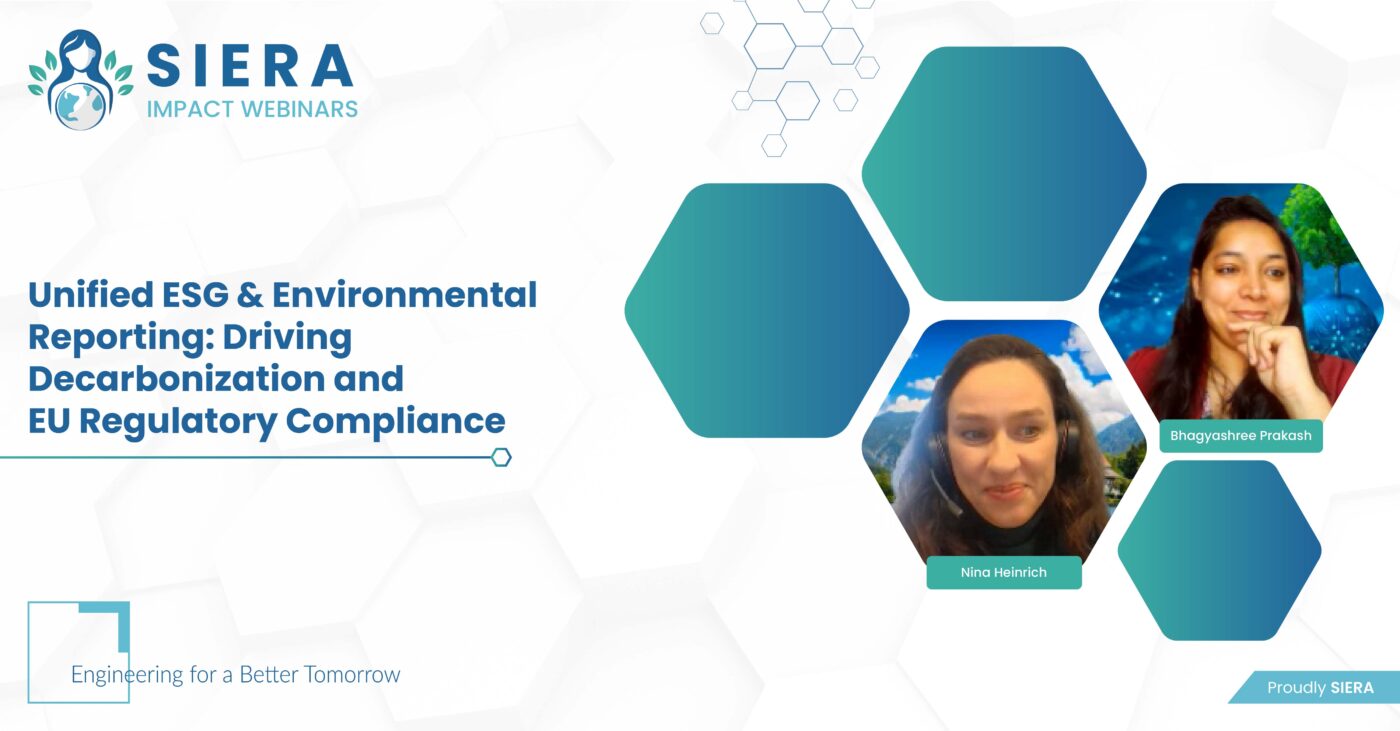
Insights from a SIERA Impact Webinar
As sustainability expectations shift from ambition to accountability, organizations across Europe and beyond are facing a decisive moment. Environmental performance, climate risk, and governance transparency are no longer peripheral topics. They are becoming central to corporate strategy, financial resilience, and regulatory compliance.
This transformation was the focus of a recent SIERA Impact Webinar, part of the SIERA Academy – Impact Series, which brings together SIERA experts to explore how engineering, technology, and governance can support a more sustainable future. The webinar, examined how unified ESG and environmental reporting is emerging as a critical enabler of decarbonization, EU regulatory alignment, and data-driven decision-making.
The session highlighted how organizations can move beyond fragmented sustainability efforts and adopt integrated, audit-ready ESG reporting frameworks that align with the Paris Agreement, the European Green Deal, and evolving EU regulations such as CSRD, ESRS, and the EU Taxonomy.
From Climate Ambition to Measurable Action
The global climate agenda has evolved rapidly over the past decade. With the adoption of the Paris Agreement, climate action became a shared responsibility, extending beyond governments to businesses, investors, and financial institutions. Climate change is now widely recognized not only as an environmental challenge, but also as a systemic economic and financial risk that can affect asset values, supply chains, access to capital, and long-term corporate resilience.
In this context, measurement and transparency are essential. Ambition without data cannot deliver results. Organizations are increasingly expected to measure, manage, and disclose their environmental and social impacts, risks, and opportunities in a structured and comparable way. Sustainability and ESG reporting have therefore evolved from voluntary communication tools into core governance and risk-management instruments.
Why Unified ESG and Environmental Reporting Matters
Unified ESG and environmental reporting refers to a single, integrated approach that connects environmental, social, and governance data with financial and operational information. Rather than producing multiple disconnected reports, organizations can consolidate ESG data into one transparent framework that supports compliance, strategy, and performance management.
By 2026, nearly 50,000 EU companies and more than 10,000 non-EU firms will fall under the scope of the Corporate Sustainability Reporting Directive (CSRD). This makes standardized, data-driven ESG reporting not just a best practice, but a regulatory necessity.
A unified approach delivers several strategic benefits:
- Regulatory compliance and risk management aligned with CSRD, ESRS, and EU Taxonomy requirements
- Accelerated decarbonization, supported by integrated carbon, energy, and waste data
- Improved data quality and transparency, enabling audit-ready disclosures
- Stronger investor confidence and improved access to sustainable finance
Key Challenges Organizations Face Today
Despite growing awareness, many organizations struggle to implement effective ESG reporting. The webinar highlighted three recurring challenges that cut across sectors and geographies.
- Fragmented ESG Data and Inconsistent Reporting
More than 40% of organizations face difficulties integrating ESG and carbon data across departments, systems, and locations. Environmental data is often scattered across spreadsheets, third-party platforms, procurement systems, and manual reports. This fragmentation leads to inconsistencies, data gaps, and higher risks of error, particularly when tracking Scope 1, Scope 2, and Scope 3 emissions.
Manual reporting processes also consume significant internal resources, slowing down reporting cycles and limiting management’s ability to act on insights in a timely manner.
- Regulatory Complexity and Compliance Burden
EU sustainability regulations require organizations to map hundreds of KPIs and sub-indicators across environmental, social, and governance dimensions. Frameworks such as CSRD, ESRS, and the EU Taxonomy demand not only disclosure of impacts, but also clear links between sustainability risks and financial performance.
Frequent updates to standards further increase complexity, forcing companies to continuously realign methodologies and data models. Without structured systems, manual mapping and interpretation increase the risk of non-compliance and regulatory fatigue.
- Limited ESG Expertise and Internal Capacity
Many organizations ,particularly small and mid-sized enterprises, lack dedicated in-house ESG expertise. According to Eurostat, only 27% of EU companies currently report having a specialized sustainability or ESG analytics team. As a result, companies often rely heavily on external consultants, increasing costs and limiting internal knowledge development.
This skills gap can slow down progress, weaken strategic integration, and prevent organizations from turning sustainability compliance into a long-term competitive advantage.
Unified ESG Reporting as a Strategic Solution
The webinar emphasized that technology-enabled, unified ESG reporting systems can address these challenges while creating long-term value.
Creating a Single Source of Truth
By centralizing environmental and ESG data across business functions, organizations can establish a single source of truth for sustainability performance. Real-time dashboards link carbon metrics with financial and governance KPIs, improving transparency and enabling faster, data-driven decisions.
Automated data validation and audit trails support ESRS assurance and significantly reduce manual effort. Organizations adopting integrated ESG data hubs have reported substantial improvements in data accuracy and reporting efficiency.
Turning Compliance into an Advantage
Structured compliance modules can automatically align data with ESRS requirements across environmental (E), social (S), and governance (G) standards. Ownership and validation workflows ensure accountability, while dynamic dashboards visualize disclosure readiness and identify gaps early in the reporting cycle.
This approach transforms ESG reporting from a reactive compliance task into a streamlined, audit-ready workflow that supports strategic planning and regulatory confidence.
Supporting Double Materiality and Decision-Making
Unified systems also support double materiality assessments, a cornerstone of CSRD reporting. By integrating stakeholder input, impact analysis, and risk assessment into a single workflow, organizations can identify material topics consistently across business units and geographies.
When environmental and social data is connected with operational and financial information, sustainability insights become actionable—supporting better prioritization, resource allocation, and decarbonization strategies.
Accelerating Decarbonization Through Data Integration
One of the strongest messages from the webinar was that unified ESG reporting fundamentally changes how organizations approach decarbonization. Instead of reviewing emissions data once a year, decision-makers gain near real-time visibility into carbon hotspots across operations and value chains.
This enables organizations to:
- Identify high-impact processes, sites, or suppliers
- Prioritize targeted efficiency measures
- Reduce energy and resource costs alongside emissions
- Strengthen resilience against energy price volatility and future carbon pricing
Decarbonization becomes a continuous, data-driven process, embedded into daily operations rather than a standalone reporting exercise.
ESG Reporting as a Foundation for Long-Term Resilience
Unified ESG and environmental reporting is no longer only about meeting regulatory requirements. It is becoming a foundation for long-term corporate resilience, enabling organizations to manage risk, attract capital, and build trust with stakeholders.
As discussed during the webinar, organizations that invest early in integrated ESG systems are better positioned to:
- Respond efficiently to investor and regulator requests
- Demonstrate credible sustainability leadership
- Align business strategy with climate and environmental goals
- Unlock sustainable finance opportunities
Join the SIERA Impact Webinar Series
The SIERA Impact Webinars, organized by SIERA Academy, are designed to translate complex sustainability and regulatory topics into practical, engineering-driven insights. Presented by experts, the series brings together specialists from across the SIERA Alliance to explore how organizations can navigate the transition toward climate neutrality and regulatory excellence.
If your organization is preparing for CSRD and ESRS reporting, seeking to accelerate decarbonization, or aiming to strengthen ESG governance, these webinars offer valuable guidance and expert perspectives.
Join our next SIERA Impact Webinar
Stay informed, build capability, and learn from experts of the SIERA Alliance as we continue to explore how unified ESG reporting and environmental engineering can shape a more sustainable future.
Engineering For A Better Tomorrow.