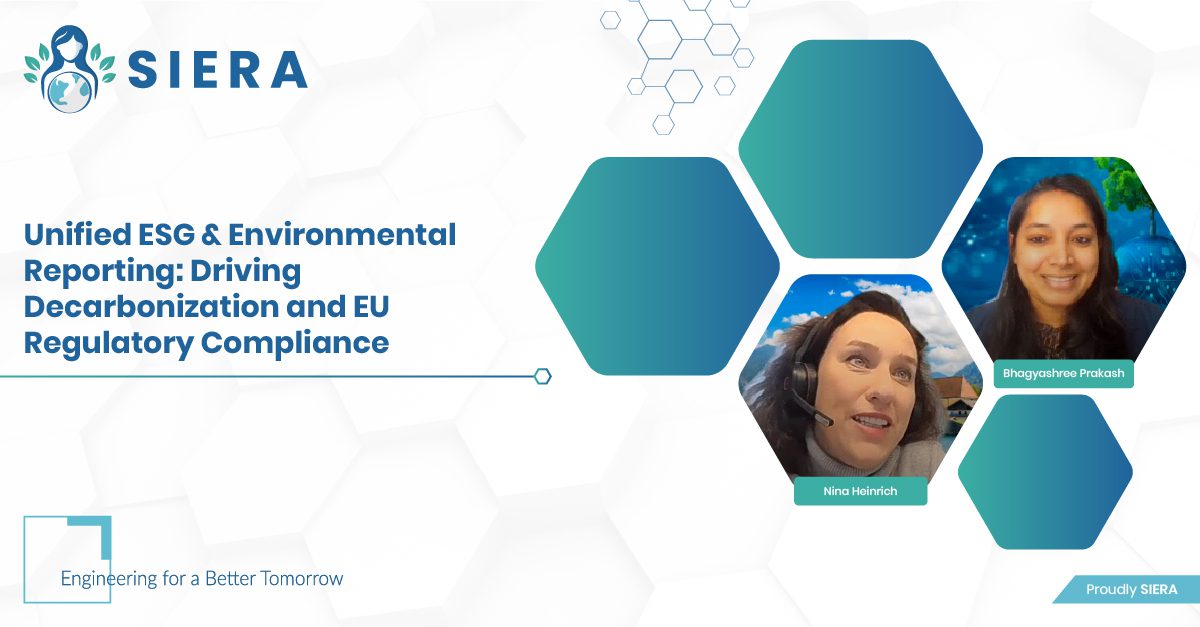
As sustainability expectations continue to intensify across global markets, organizations are under growing pressure to move beyond high-level commitments and demonstrate measurable, auditable progress. Regulators, investors, customers, and employees increasingly expect companies to show how ESG data supports climate action, regulatory compliance, and long-term business resilience.
That was the focus of SIERA’s recent webinar, “Unified ESG & Environmental Reporting: Driving Decarbonization and EU Regulatory Compliance.” The session explored how organizations can align ESG reporting with decarbonization goals while responding to evolving EU requirements such as the Corporate Sustainability Reporting Directive (CSRD), European Sustainability Reporting Standards (ESRS), and the EU Taxonomy.
The webinar highlighted a clear message: unified ESG and environmental reporting is no longer just a compliance exercise, it is becoming a critical business capability.
SIERA helps organizations address sustainability and compliance challenges through an environmental engineering-led approach to ESG and environmental reporting. By combining technical expertise with digital solutions, SIERA supports companies in managing environmental data, improving reporting accuracy, and aligning operational performance with evolving regulatory requirements. This approach helps businesses translate complex environmental and sustainability requirements into practical, measurable actions that support decarbonization, compliance, and long-term resilience.
Why This Topic Matters Now
Over the past year, sustainability has shifted from a “nice-to-have” initiative to a business-critical priority. Stakeholders now expect more than statements of intent. They want:
- Evidence of climate action
- Accurate and consistent ESG data
- Audit-ready reporting processes
- Clear links between sustainability performance and business strategy
At the same time, companies must navigate increasingly complex reporting obligations while ensuring that their decarbonization efforts remain credible, measurable, and aligned with broader climate commitments such as the Paris Agreement.
This is where unified reporting becomes essential.
What the Webinar Covered
The webinar agenda focused on five core areas:
- Challenges overview
- Solutions
- Core technical concepts
- Positive impacts
- Questions and answers
Together, these topics provided a practical view of how businesses can strengthen ESG reporting while building a stronger foundation for sustainability performance and compliance.
Key Challenges Organizations Are Facing
A major theme of the webinar was the operational difficulty many companies still face in building a cohesive ESG reporting approach.
1. Fragmented ESG Data
One of the most common barriers is disconnected data spread across departments, systems, and reporting processes. According to the webinar, more than 40% of organizations struggle to integrate ESG data effectively, which leads to:
- Inconsistent reporting
- Higher risk of error
- Delayed disclosures
- Reduced confidence in reported outcomes
When environmental, social, governance, energy, carbon, and compliance data are managed separately, it becomes much harder to produce reliable, decision-useful reporting.
2. Regulatory Complexity and Compliance Burden
Organizations are also managing an increasingly demanding regulatory landscape. Aligning disclosures across CSRD, ESRS, and EU Taxonomy requirements can be resource-intensive, especially when reporting processes are still manual or distributed across multiple teams.
This complexity can slow reporting cycles and make it difficult to maintain full traceability from underlying data to final disclosures.
3. Lack of ESG Expertise
Another challenge discussed in the webinar is the shortage of in-house ESG knowledge. Many organizations, particularly SMEs, do not yet have the internal capabilities needed to:
- Interpret evolving ESG frameworks
- Conduct double materiality assessments
- Align reporting with ESRS requirements
- Translate sustainability data into strategic action
Without the right expertise, compliance can become reactive rather than structured and forward-looking.
Core Takeaway: Integration Is the Path Forward
A central insight from the session was that organizations need a more centralized, connected approach to ESG and environmental reporting.
Rather than treating reporting, decarbonization, risk, and compliance as separate workstreams, companies should connect them through a unified framework that supports:
- Centralized data mapping
- Clear identification of value chain hotspots
- Better traceability across material topics
- Stronger alignment between ESG reporting and transition strategies
This integrated model helps organizations improve both compliance readiness and sustainability performance.
Solutions Highlighted in the Webinar
The webinar presented several practical solution areas to help organizations improve ESG reporting maturity and reduce complexity.
AI-Powered Materiality and IRO Identification
One of the most notable areas covered was the role of AI-powered materiality and impact, risk, and opportunity (IRO) identification.
This approach can help organizations:
- Suggest KPIs, reporting topics, and narratives aligned with ESRS
- Create visual mapping between material KPIs and environmental, social, and governance impacts
- Connect value chain hotspots directly to double materiality assessment scoring
- Feed mapped data into ESRS disclosures such as SBM-1, SBM-3, and IRO-1
- Improve traceability from data source to disclosure output
This was presented not simply as an efficiency tool, but as a way to improve decision-making quality and ensure reporting reflects what is truly material to the business.
Structured Assessment and Disclosure Workflows
The webinar also emphasized the value of structured workflows for reporting and compliance. Key capabilities mentioned included:
- Dynamic dashboards to visualize disclosure readiness and identify gaps
- Export-ready outputs that generate ESRS-compliant report sections
- Centralized assessment workflows to reduce manual effort
- More transparent processes for sustainability teams and stakeholders
These capabilities can help turn ESG reporting from a fragmented exercise into a repeatable and scalable process.
Positive Impacts of Unified ESG Reporting
The session made it clear that unified ESG reporting delivers value well beyond regulatory compliance.
Faster Responses
Structured data collection and clearer workflows reduce delays, making it easier for organizations to respond to internal and external reporting needs.
Higher Credibility
Improved transparency, consistency, and explainability strengthen trust with regulators, investors, and other stakeholders.
Clearer Strategic Focus
Data-driven materiality prioritization enables organizations to focus on the topics that matter most, improving:
- Resource allocation
- Strategic planning
- Risk management
- Alignment between ESG priorities and business KPIs
Ongoing Visibility
When reporting data is centralized and visible through dashboards and mapped workflows, organizations gain a clearer picture of readiness, gaps, and progress over time.
Better Data Quality and Transparency
A unified ESG framework creates a single source of truth, reducing reporting errors and strengthening confidence in sustainability disclosures.
Greater Access to Capital and Competitive Advantage
The webinar also highlighted that stronger ESG reporting can support:
- Access to green financing
- Improved brand reputation
- Increased resilience
- Better positioning with partners, investors, and customers
In other words, robust ESG reporting can become a source of strategic differentiation.
Decarbonization and Compliance Must Work Together
A particularly important message from the webinar was that decarbonization and reporting should not be treated as separate priorities.
To meet stakeholder expectations and regulatory demands, companies need to show how emissions reduction efforts connect to:
- Material sustainability issues
- Risk and opportunity assessments
- Governance and decision-making
- Reported ESG metrics and disclosures
This alignment is what enables organizations to move from fragmented sustainability activity to a more credible and business-relevant climate strategy.
About SIERA
At SIERA, we help organizations simplify sustainability and compliance by enabling smarter, more connected ESG and environmental reporting. As businesses face rising expectations around transparency, climate accountability, and regulatory readiness, SIERA supports the shift from manual, fragmented processes to more unified and actionable reporting approaches.
By helping organizations improve visibility, streamline workflows, and align sustainability data with regulatory frameworks, SIERA empowers teams to build stronger reporting foundations and make ESG performance more strategic.
The webinar, “Unified ESG & Environmental Reporting: Driving Decarbonization and EU Regulatory Compliance,” reinforced a critical point for today’s organizations: success in sustainability now depends on the ability to connect data, strategy, compliance, and action.
As ESG regulations evolve and climate expectations intensify, unified reporting is becoming essential for companies that want to:
- Improve disclosure quality
- Reduce compliance burden
- Strengthen stakeholder trust
- Advance decarbonization efforts
- Build long-term competitive advantage
Organizations that invest in integrated ESG reporting capabilities today will be better positioned to navigate regulatory change and lead with confidence tomorrow.
Join Our Future Webinars and Events
Want to stay ahead of ESG reporting requirements, sustainability trends, and regulatory developments?
Join SIERA’s upcoming webinars and events to:
- Learn from subject matter experts
- Explore practical approaches to ESG and environmental reporting
- Stay informed on evolving EU and global sustainability regulations
- Discover how technology can support compliance, transparency, and decarbonization
Don’t miss the next conversation. Visit SIERA to learn more and stay connected for future webinars, insights, and events.
Engineering For a Better Tomorrow